Shipping a medical product requires more than choosing a transport route. Buyers need to identify the exact product and intended market, align supplier and shipment records, confirm storage and handling conditions, plan packaging and lot traceability, and route regulatory questions to the responsible compliance owner. The right checks depend on product classification and destination; a general shipping checklist cannot replace product-specific regulatory review.
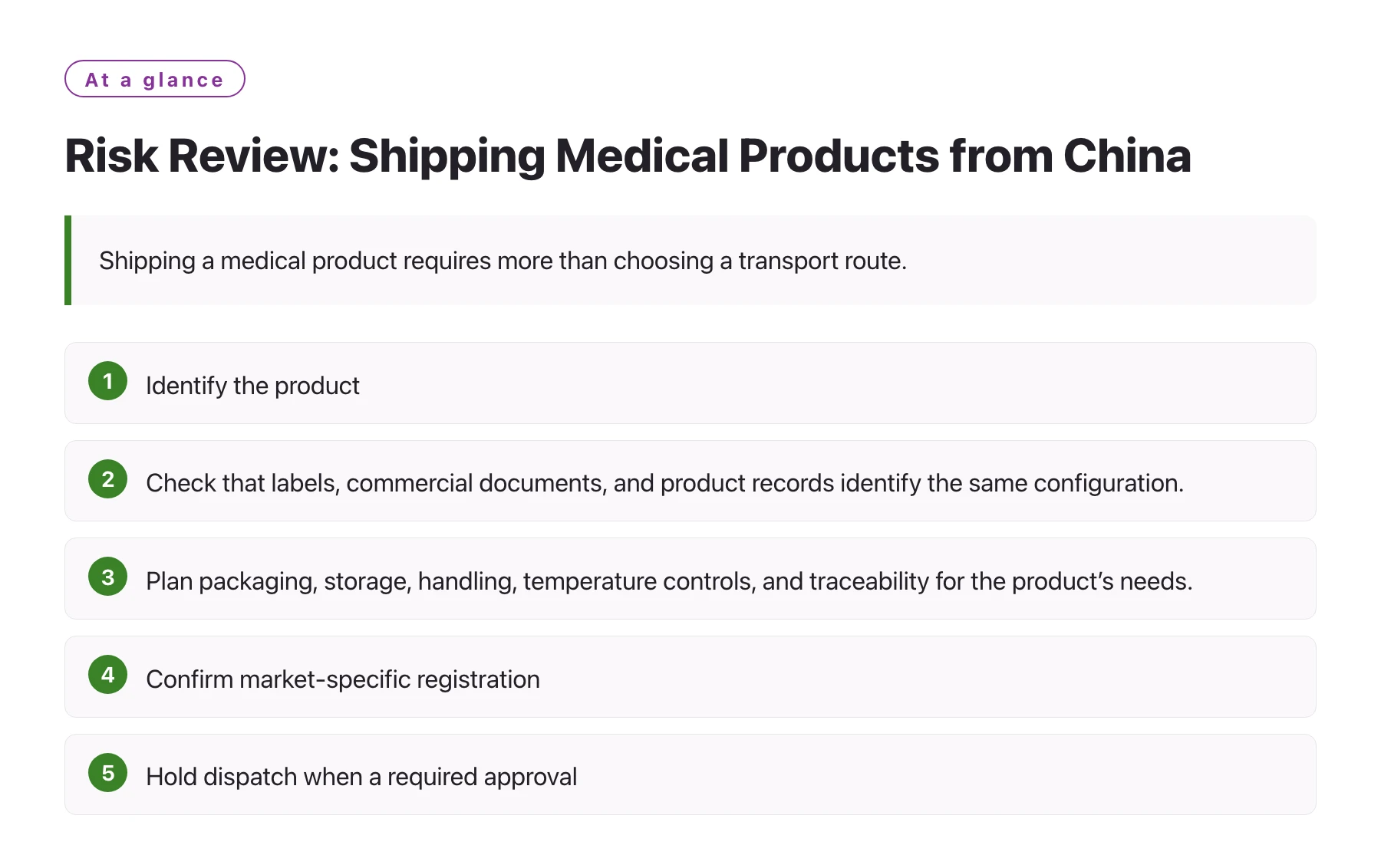
Key takeawaysIdentify the product, intended use, destination, importer, manufacturer, and lot before booking. · Check that labels, commercial documents, and product records identify the same configuration. · Plan packaging, storage, handling, temperature controls, and traceability for the product’s needs. · Confirm market-specific registration, documentation, and import responsibilities with qualified owners. · Hold dispatch when a required approval, record, or shipment condition remains unresolved.
Treat product compliance, shipment readiness, and transport execution as linked workstreams with named owners.
Classify the product and define the destination
Start by identifying the product accurately: description, intended use, model, configuration, manufacturer, production site, and applicable lot or serial identifiers. Similar-looking products can fall under different regulatory definitions depending on intended use and claims. Record the importer of record and the markets where the shipment will be placed or used. Do not let a generic invoice label obscure the product’s actual identity.
Ask the responsible regulatory or quality owner to confirm the applicable classification and requirements before committing the shipment date. The review may affect labeling, evidence, storage, import declarations, and which parties must be registered or authorized. If the shipment includes accessories, components, kits, or replacement parts, verify whether the documents describe those items separately or as part of a system.
Buyers sourcing through medical supply manufacturers in China should identify the actual producing site and who controls each process. Clarify whether the quoted supplier is the manufacturer, an authorized distributor, or another intermediary, and establish who is responsible for production records, changes, release, and shipment documentation.
Build a controlled document set
Prepare a document register before cargo is ready. Depending on the product and market, the file may include purchase order, specification, commercial invoice, packing list, lot or serial records, country-of-origin information, transport documents, labels, instructions, declarations, test records, and certificates required by the buyer or regulator. Assign an owner and version to each item. A folder of files without a scope or status register is difficult to reconcile under time pressure.
Match the product name, model, manufacturer, site, quantity, lot, and dates across documents. Investigate differences in transliteration, abbreviations, trading names, and address formatting before dispatch. Ensure the packing list and carton marks can be tied to the product records and that the commercial description is accurate for customs and regulatory review. Ask a broker or compliance specialist to validate classifications and declarations.
For U.S.-bound medical devices, FDA guidance explains that entry review checks relevant establishment registration and device listing information and that mismatches can prompt additional review or affect importation. The exact requirements vary by device and responsible party, so the importer should verify its own obligations and product status using current FDA information before shipping. [1]
Confirm the product and lot are released
Define what “released for shipment” means in the purchase and quality records. Confirm final inspection status, unresolved deviations, lot or serial assignment, quantity, labeling, packaging, and any required quality or regulatory approvals. The release decision should come from the authorized owner and refer to the specific lot. A completed shipping booking or a supplier’s “ready” message does not replace product release.
Review any change made after sample or document approval. A substitute material, label, facility, component, packaging configuration, or sterilization or processing step may affect evidence or market obligations. Require written change review and confirmation that current documents correspond to the goods. If the buyer cannot determine the effect, pause the affected shipment decision until a qualified reviewer resolves it.
Retain the final approved specification, inspection record, release approval, and lot or serial details with the order. These records make it possible to connect subsequent receiving, storage, distribution, and complaint handling to the shipment actually sent. Use identifiers that will remain readable and accessible after outer cartons are removed.
Plan packaging, storage, and handling
Identify any product-specific limits for temperature, humidity, light, vibration, orientation, shock, cleanliness, or shelf life. The manufacturer or qualified product owner should define these conditions and the evidence needed to show they were maintained. Do not invent a handling range based on a similar product. Where controlled transport is required, confirm the provider can monitor, document, and report excursions according to the approved plan.
Review packaging as a system of product protection, identification, and handling. Confirm inner packaging, barriers, cushioning, seals, labels, carton strength, palletization, and any tamper-evident features required by the specification. If the package itself is part of product sterility or barrier performance, route that review to qualified specialists and verify the exact packaging configuration.
Check storage and transfer points along the route: factory staging, consolidation warehouse, port, aircraft or vessel, customs hold, local warehouse, and final delivery. Identify who monitors conditions and who responds to an excursion, damaged carton, or broken seal. Include instructions for temporary holds and escalation contacts in the shipment plan.
Choose the route and coordinate handoffs
Compare air, ocean, courier, or multimodal options against product characteristics, delivery window, handling needs, shipment size, and cost assumptions. A faster service is not automatically suitable if it cannot preserve required conditions or provide the records the product owner needs. Confirm transit estimates, service exclusions, cutoff dates, booking requirements, and destination handling with the carrier or freight forwarder.
Agree the named place, delivery term, responsible parties, and handoff points in the commercial documents. Clarify who arranges pickup, export clearance, main carriage, insurance, import clearance, duties, destination handling, and final delivery. Ask who will receive customs or regulator queries and which party can provide additional product information. Do not assume a supplier quotation includes every logistics or compliance service.
Coordinate the booking only after production and documentation dates are credible. Work backward from the required arrival date to include inspection, release, document review, consolidation, export procedures, transit, customs processing, and receiving capacity. Identify schedule dependencies and a route for notifying all parties if a required milestone slips.
Prepare for customs and import review
Work with a qualified customs broker and the importer’s compliance team on product classification, declaration details, valuation, origin, permits, and any product-specific data. Provide accurate commercial descriptions and matching manufacturer and consignee information. Where regulators require identifiers or prior authorizations, verify them before goods are handed to the carrier. Customs requirements are jurisdiction-specific and can change; use current official guidance.
The FDA notes that imported medical devices offered for entry into the United States are subject to applicable FDA and customs requirements, and that information submitted at entry is used for review. That is a U.S.-specific example, not a rule for every medical product or every destination. Confirm the correct product pathway, importer duties, and entry data with the responsible specialist for the shipment.
Agree who will respond if a shipment is held or additional evidence is requested. Keep a contact tree for supplier, importer, broker, carrier, compliance owner, and receiving location. Store digital copies of the final documents where the responsible parties can retrieve them quickly, while protecting confidential technical or patient-related information.
Track the shipment and preserve chain of custody
Record the carrier, booking number, container or airway-bill reference, seal number where relevant, pickup time, handoff location, and expected arrival. For controlled shipments, capture monitoring device identity, calibration or setup records where applicable, and instructions for downloading data. Define who checks tracking and at what milestones rather than relying on an email alert that may be missed.
At each transfer, note the party taking custody and any visible damage, delay, temperature excursion, seal issue, or documentation discrepancy. Decide in advance when an exception requires quarantine or a technical disposition. Do not let a receiving team place potentially affected stock into saleable inventory before the designated quality owner has reviewed the event.
On arrival, reconcile package counts, labels, lot identifiers, condition, and shipment documents with the release file. Record any shortage or damage promptly and preserve packaging and photographs where a claim or investigation may depend on them. Update inventory status only after the required receiving and compliance checks are complete.
Close the loop after delivery
Archive the final purchase and shipment records with the product and lot identifiers. Keep records in the format and for the period required by the buyer’s quality system and applicable rules. Ensure the shipment can be located in future distribution or recall exercises, and that the importer knows which customer or facility received each lot where traceability is required.
Review the route after delivery: schedule performance, document accuracy, condition on arrival, exception response, and cost differences from the quotation. Note whether the original assumptions were correct and whether a different carrier, packaging, buffer, or release milestone is needed. Feed findings into future purchase orders and supplier instructions.
Keep product complaints, adverse-event reporting, returns, and field actions in the appropriate quality and regulatory processes. A logistics record can support an investigation, but it should not be treated as a substitute for the required product surveillance or reporting system. Assign these responsibilities to the qualified owner before the first shipment.
Sources
Frequently asked questions
Are shipping documents enough to prove a medical product can be imported?
No. Documents support review, but the importer must confirm the product-specific requirements and approvals for its destination and intended use.
Can all medical products use the same shipping checklist?
A shared logistics framework can help, but classification, handling limits, labeling, and import duties depend on the exact product, its intended use, and the destination market.
When should cargo be booked?
After the product release path, document owners, handling conditions, route, and schedule dependencies are clear enough to support the planned dispatch.
What should happen if transport conditions are exceeded?
Follow the product-specific excursion procedure, preserve monitoring and custody records, and obtain a disposition from the qualified quality or regulatory owner before use or distribution.