Designing the Rinse Profile of a Men's Cleanser
The rinse profile of a men's cleanser is a design choice, not an afterthought. Foam speed, slip, rinse time and post-rinse feel should be tested with a fixed dose and water routine before a brand chooses among soap-based, amino acid, compound or exfoliating concepts.
Key takeaways
- Define the intended rinse experience before selecting a cleanser type.
- Control dose, water temperature and massage time in every comparison.
- Evaluate foam and post-rinse feel as separate attributes.
- Test the final texture through its intended tube, pump or powder pack.
What does a rinse profile include?
Write a sequence from wetting to towel dry. Record how quickly the product spreads, when foam appears, how much water clears it and what the skin feels like after one and ten minutes. This turns 'clean but not tight' into observable development targets.
The profile should reflect the user's setting. A gym product may need fast dispensing and a short rinse, while a home routine can support a creamier massage. Neither is universally better; each serves a different brief.
How do cleanser type and texture differ?
Yunmei lists four cleansing types—Soap-Based, Amino Acid, Compound and Exfoliating Facial Cleanser—and five textures: Cream, Creamy, Gel, Foamy and Powdered Facial Cleanser. Type describes the cleansing approach; texture describes how the user handles the product.
Do not use the two lists as interchangeable menus. A development brief should name both the cleansing direction and the delivery texture, then let the formulator assess whether that combination can meet stability, pack and sensory targets.
| Dimension | Published options | Buyer decision |
|---|---|---|
| Cleansing type | Soap-Based / Amino Acid / Compound / Exfoliating | Cleansing direction |
| Texture | Cream / Creamy / Gel / Foamy / Powdered | Handling and delivery |
What should a controlled sink test measure?
Dispense the same mass or pump count, use the same water temperature and massage for a fixed thirty seconds. Count rinses or measure water volume if the project requires more precision. Pat dry in the same way before recording after-feel.
When comparing a men's facial cleanser, keep fragrance and colour neutral if they are not the decision. Strong sensory cues can influence perceived cleanliness and distract the panel from slip, residue or tightness.
How should foam be interpreted?
Foam volume is one observation, not proof of cleaning performance or mildness. Record onset, bubble character and collapse separately, then compare those observations with the intended positioning. A low-foam product can still be coherent if the brand explains and designs for that experience.
Use photographs only as support because camera angle and vessel size can distort comparisons. A short written method and time-stamped observation are more reproducible than a dramatic foam image.
Where does exfoliation change the method?
An exfoliating concept adds particle distribution, massage feel and rinse clearance to the review. Check whether the product remains uniform through the package and whether the instructed use can be followed without excessive rubbing.
Keep claim and frequency discussions within the evidence available for the finished formula. The sample panel should describe experience and visible product behaviour, not turn a short sink test into a treatment conclusion.
How does packaging alter the rinse experience?
A pump or tube determines the dose entering the test. A powdered format adds opening, pouring and activation steps. Review leakage, clogging, wet-hand handling and residue around the closure alongside the formula.
Run compatibility with the selected pack rather than assuming a generic component represents it. Viscosity changes during storage may affect dose even when the bulk formula still looks acceptable.
When is the profile ready to approve?
Set pass ranges for dose, spread, rinse and after-feel, then link them to one formula and pack version. Archive a retained sample and the panel method so production output can be compared with the agreed reference.
Yunmei publishes four to eight weeks for an existing-formula ODM route and three to six months for OEM development. Early clarity on the rinse profile reduces late revisions inside either window.
Worked example: comparing rinse water
If sample A clears after three 250 ml rinses, it uses 750 ml in the controlled test. Sample B needs five rinses, or 1,250 ml. B therefore uses 500 ml more, a 66.7% increase over A. This is a bench comparison under one method, not a universal consumer-use figure.
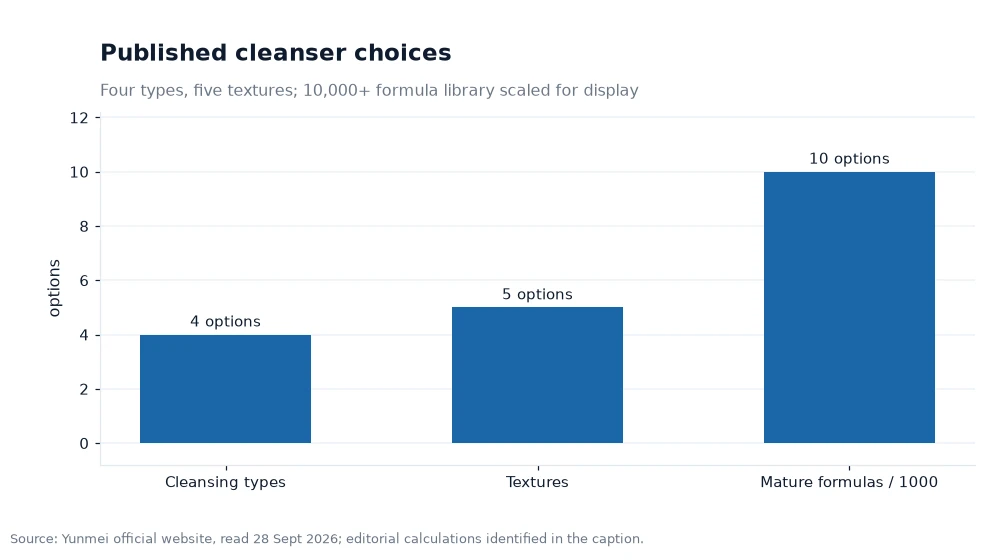
The small type and texture counts are deliberate decision menus; the much larger formula-library number does not remove the need to specify which experience the brand is trying to build.
Frequently asked questions
Does more foam mean a cleanser works better?
Not by itself. Foam is a sensory and format observation. Evaluate it alongside spread, rinse, residue, after-feel and the intended product positioning.
Can a brand choose texture before cleansing type?
It can state a texture preference, but the final brief should connect texture with a suitable cleansing direction, package and user routine.
Why test with the final package?
The package sets the dose and handling experience. Leakage, clogging or a changing pump output can alter an otherwise acceptable formula.
Approve the wash, not only the jar
A cleanser earns approval at the sink. Use a repeatable routine, document both immediate and delayed feel, and make the controlled result part of the production reference. A consumer test can use a simple rinse diary: sample code, dose, water condition, massage duration, rinse effort and after-feel at two fixed intervals. Participants should complete the sheet independently, then return the samples in the same order. The team can compare notes after collecting the forms. This method will not replace specialist testing, but it can identify which direction deserves another laboratory round. If results are mixed, look for a pattern by routine rather than averaging away the differences. A gym user may value fast rinsing, while another user may care more about the feel after towel drying. Translate those patterns into a narrower brief for the next iteration. Before the project is closed, compare the approved record with the exact item being purchased. Check the version, quantity, component and evidence reference rather than relying on a remembered conversation. Ask the supplier to confirm any open assumption in writing, and save that confirmation with the quotation. If an answer changes the brief, update the sample and calendar before releasing the next commitment. This final reconciliation gives the brand a clear basis for later questions from production, quality or customer service. It also makes the next order easier to plan because the team can distinguish what was learned from what was merely assumed during the first launch. It is also worth checking how a cleanser performs across ordinary variation in use. People may use cooler or warmer water, apply a different amount or spend less time massaging than the controlled panel. These observations should not replace the standard comparison, but they can identify a fragile concept that only works under ideal conditions. Ask a few participants to repeat the routine on another day and note whether their experience changes. If results vary, investigate dose and instructions before changing the formula. The final product page and packaging should describe a routine that the sample can actually support. Clear instructions make a sensory profile more repeatable and give the brand a fairer basis for evaluating customer feedback after launch. Review Yunmei’s OEM/ODM manufacturing overview and use the same written brief for every sample round.
Yunmei's men's cleanser options and public manufacturing context were read 28 Sept 2026. Rinse-test methods and water-volume arithmetic are illustrative.[1].