Feature Updates and How Platforms Communicate Them
Platform changes reach readers through four channels, and each one is good at something different: an in-app notice arrives when it matters, a blog post explains why something changed, a dated policy page settles what the rules now say, and silence tells you how a platform expects to be read. Crushon's public history is short and easy to audit — blog entries dated through 2024 and 2025, a compliance statement updated on 2025-02-08 — and working through it takes less time than one week of ordinary use, which at four sessions of 15 minutes is just one hour.

Key takeaways
- Match the channel to the question: notices for what changed today, blog posts for why, policy pages for what is binding.
- A date is the most important field on any announcement. The compliance statement carrying 2025-02-08 can be compared with previous versions; an undated notice cannot.
- Auditing a platform's public history costs about two hours a year at ten minutes a month — less than a week of 15-minute sessions.
- If a change affects something you rely on, test it in one short session rather than reading three summaries of it.
The four channels and what each is for
In-app notices are the fastest channel and the least informative. They exist to stop you being surprised by a moved button, and they are usually written for a five-second read. Treat them as an alert rather than an explanation: if a notice changes something you use every week, it is worth following up somewhere with more room.
Blog posts carry the reasoning. A platform that publishes tutorial and news entries — the kind collected on an AI chat blog, with pieces dated across 2024 and 2025 — gives readers a way to understand a change in context rather than guessing at motive. The posts are also where conventions get established: a short guide on how a feature is meant to be used is often more useful than the release itself.
Policy and compliance pages are the binding channel. They move slowly, they carry dates, and they are the only place where wording can be compared version to version. The 2257 statement updated on 2025-02-08 is a good example of the type: it defines what the content is, and because it is dated, a reader can tell whether it has changed since they last looked. The fourth channel is silence — the absence of an announcement where an announcement would be expected. It is not proof of anything on its own, but a platform that changes something material without a dated note is telling you how much weight to give its notes.
| Channel | Latency | Best for | What it cannot tell you |
|---|---|---|---|
| In-app notice | Immediate | Knowing something changed today | Why, or what else moved with it |
| Blog post | Days | Context, tutorials and the reasoning behind a feature | Binding rules |
| Policy or compliance page | Months | What the rules are, and when they last changed | Day-to-day product behaviour |
| Changelog or release note | Weekly at best | Seeing a pattern of work over a season | Anything not considered worth listing |
| Silence | Never | Calibrating how much to trust the other four | Nothing directly, but it shapes your reading |
How to read a release note without wasting an evening
Three questions cover most announcements. Does this change anything I use weekly? Does it change anything I have already paid attention to — saved characters, continuing threads, privacy wording? And is there a date and an owner attached, so I can check back? If the answer to the first two is no, the note can be filed and forgotten. If either is yes, one short session using the feature in question will teach you more than any summary.
The measuring habit matters more than the reading habit. Announcements accumulate into a record, and the record is where patterns show: a platform that ships small improvements regularly reads differently from one that makes rare large changes. Neither is automatically better, but you cannot tell which you are using unless you keep the dates. Write the date and the one-line summary in the same note each month, and after a year you will have a document no announcement page provides: your own account of how the product changed while you were using it.
Worked example: costing the audit
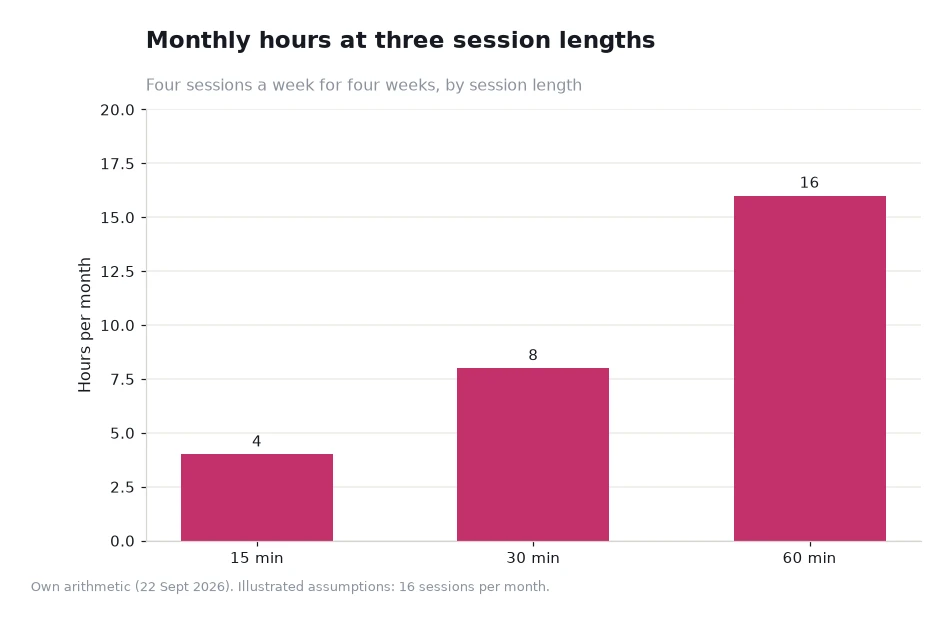
Take a light usage pattern: four sessions a week for four weeks is 16 sessions a month. At 15 minutes each, that is 16 × 15 = 240 minutes, or 4.0 hours a month. At 30 minutes, it is 16 × 30 = 480 minutes, or 8.0 hours. At 60 minutes, it is 16 × 60 = 960 minutes, or 16.0 hours. Those are the figures the chart beside this section plots, and they are illustrative assumptions rather than platform data.
Now price the reading. Ten minutes a month checking the blog and any dated policy pages comes to 120 minutes a year, or 2 hours. Set against the 15-minute pattern, that is half of one month's usage — 2 hours against the 48 hours a year the same pattern represents. Even at the 60-minute pattern, where the year runs to 192 hours of sessions, the audit stays under 1.1% of the total. The conclusion is unglamorous: reading what a platform publishes is cheap relative to the time it organises, and the cost of being surprised is higher.
Reading the primary pages yourself
Start with the product description at https://crushon.ai/ai-porn-chat, which is where the platform's own account of its features and its FAQ live. From there, the AI chat blog holds the dated posts that show how the product has been described over time, and the 2257 compliance statement is the page to check whenever you want to confirm what the content is and when that description last changed.
Three pages, one bookmark each, and a monthly ten-minute review is the whole routine. It is not a research project; it is the same discipline as reading the notes that come with anything you rely on, applied to a product you use for hours a month. The product page also answers the most common questions about what Porn Chat AI refers to and how realistic it claims its responses are, which is a fair place to start when a new feature changes how conversations behave.
Frequently asked questions
Which channel should I trust most?
The dated one. Policy and compliance pages are the only places where wording can be compared from version to version, so they carry the most weight when two channels appear to disagree.
How often should I check for updates?
Once a month is enough for a habit of a few sessions a week. Ten minutes covers the blog and any dated pages, which works out at about two hours a year.
Do in-app notices matter?
They matter as alerts. A notice tells you that something changed today; it rarely explains the reasoning or what else moved alongside it, so follow up on anything you rely on.
Put the review in the calendar
Pick a date, open the blog and the two dated pages, and note one line about anything that changed since last month. Within three reviews you will have a short history of your own, which is a better guide to a platform than any single announcement. If something you use weekly has moved, test it in one session and write down what you found.
Data and sources: the platform's product description and FAQ[1] and its dated compliance statement[2], read 22 Sept 2026. Session-length and audit figures are illustrative assumptions, not platform data. Intended for adult readers aged 18+.